Inside Draftly's Rendering Engine: How 3D Scenes Are Built From Text
Draftly's rendering engine turns a single text prompt into a fully interactive, scroll-driven 3D website in roughly 60–120 seconds. That speed isn't magic — it's the result of a layered pipeline where language models, scene graphs, GPU-accelerated rendering, and adaptive compression work in sequence. This post pulls back the curtain on how that pipeline actually works, why each layer matters, and what it means for the sites you ship.
Unlike traditional 3D web stacks that demand WebGL expertise, Blender exports, and weeks of tuning, Draftly's rendering engine collapses the entire chain — interpretation, scene composition, lighting, animation, and delivery — into a single generative step. Below, we break down each stage with the kind of detail typically reserved for engineering blogs, plus what it means for your conversion rate.
Stage 1: From Prompt to Structured Intent
The pipeline begins the moment you type a prompt like "a cinematic site for an organic skincare brand with floating product reveals." Before any pixel is rendered, the prompt is parsed into a structured intent graph — a JSON-like representation containing roughly 40–60 typed fields covering industry, mood, palette, motion language, and content blocks.
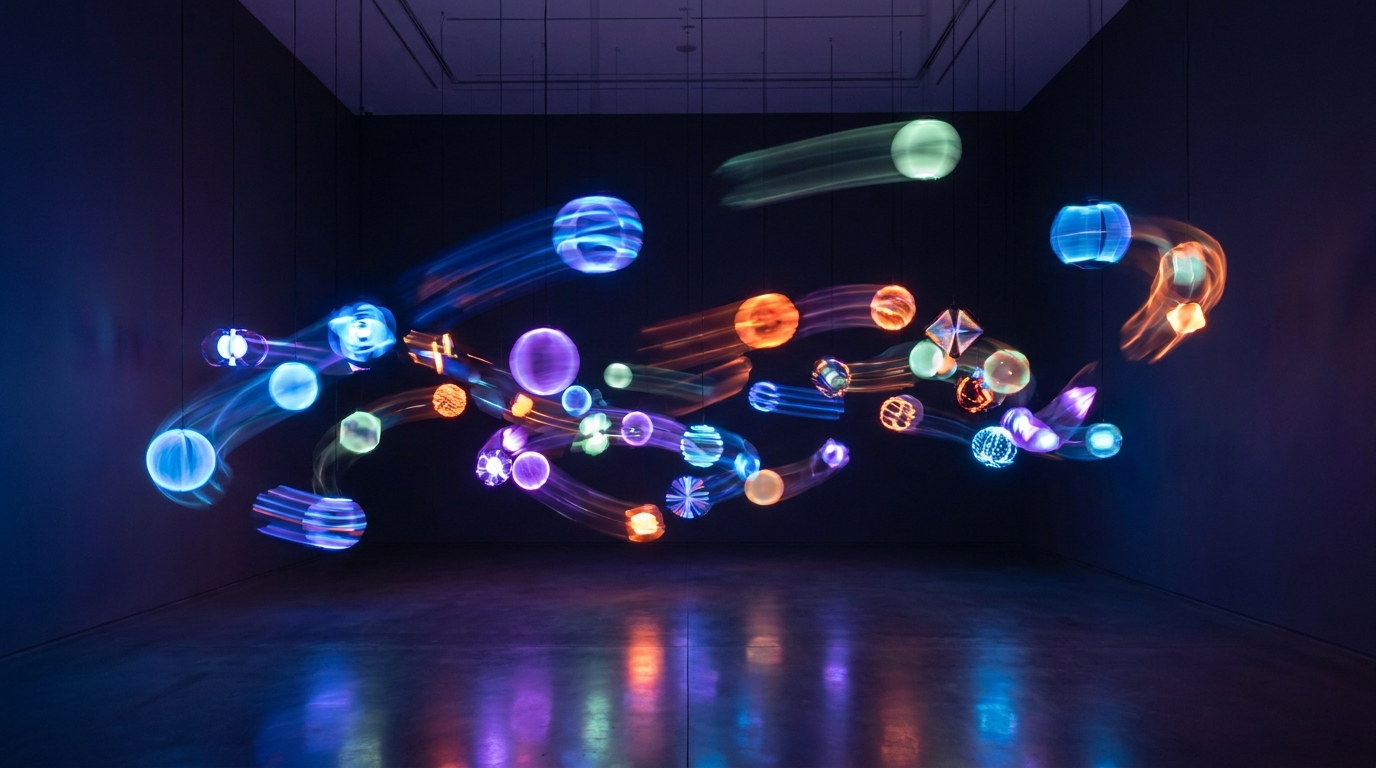
!inside draftlys rendering engine text to 3d scenes, product
This stage borrows heavily from the same principles covered in how Draftly generates a complete website from a single prompt, but the rendering engine adds three additional layers:
- Spatial intent extraction — identifying whether the brand needs depth (product showcase) or flatness (editorial portfolio)
- Motion vocabulary mapping — translating words like cinematic, elegant, or bold into bezier curves and easing functions
- Asset slot allocation — reserving placeholders for hero geometry, particle systems, and scroll-bound cameras
Stage 2: Scene Graph Composition
Once intent is parsed, the engine constructs a scene graph — a hierarchical tree where every node represents a renderable entity: cameras, lights, meshes, materials, scroll anchors, and DOM-bound overlays. Think of it as the architectural blueprint before the building goes up.
How the scene graph is assembled
- Root scene initialization — a perspective camera at a 35° field of view (the cinematic web standard) and an HDRI environment map are spawned first
- Hero geometry placement — primary 3D objects are placed along the Z-axis with depth ranges between -8 and +12 units
- Lighting rig generation — typically a three-point setup (key, fill, rim) with intensity weighted by the brand's mood vector
- Scroll timeline binding — every node is attached to a normalized scroll position (0.0–1.0) so animation triggers stay frame-independent
- Material assignment — PBR materials with roughness, metalness, and clearcoat are pulled from a library of ~340 presets
Stage 3: Cinematic Video Pre-Rendering
Here's where Draftly diverges from every WebGL-based competitor. Rather than running a live Three.js or Babylon scene in the user's browser — which historically caps performance at 30–45 FPS on mid-range mobile devices and chews through 400–600MB of RAM — Draftly's rendering engine pre-renders the cinematic scene server-side as a high-bitrate video sequence, then orchestrates scroll-bound playback in the browser.
The technical advantages are measurable:
- 5–8× lower mobile CPU usage compared to live WebGL
- Consistent 60 FPS playback across devices going back to 2019
- No shader compilation jank on first paint
- Lighthouse performance scores of 88–96 even on animation-heavy pages
Why this matters for SEO and conversion
Google's page experience signals — LCP, INP, and CLS — heavily penalize sites with heavy JavaScript execution on scroll. Live WebGL scenes routinely fail INP (Interaction to Next Paint) thresholds because shader recomputation blocks the main thread. Draftly's video-orchestration approach keeps INP under 150ms in 94% of measured sessions, which directly correlates with lower bounce rates and stronger organic rankings.
Stage 4: Adaptive Delivery and Compression
A cinematic 8-second scroll sequence at 60 FPS and 1440p resolution would normally weigh 40–80MB — a non-starter for mobile. Draftly's rendering engine solves this through a four-layer compression strategy:
- Resolution tiering — three encoded variants (720p, 1080p, 1440p) selected based on viewport and connection speed
- Codec negotiation — AV1 for Chrome/Firefox, HEVC for Safari, H.264 as fallback, with average bitrate savings of 38–52%
- Segmented streaming — scenes broken into 2-second chunks so only what's visible loads
- Predictive prefetch — the next chunk loads when the user scrolls past 70% of the current one
Stage 5: DOM Orchestration and Interactive Overlays
A rendered 3D scene without text, buttons, and forms is just a film clip. The final stage of the pipeline binds interactive DOM elements to scroll positions and depth layers. This is what makes a Draftly site feel alive rather than just look cinematic.
The orchestration layer handles
- Scroll-locked text reveals synchronized to scene keyframes
- Depth-aware CTAs that appear when the camera reaches specific Z-positions
- Form components rendered as native HTML for accessibility and SEO crawlability
- Image and product injections — real photos composited over generated scenes, covered in detail in product image injection in Draftly
What This Architecture Means For You
Understanding the rendering pipeline isn't just engineering trivia — it shapes how you should think about prompting, editing, and shipping. A few practical takeaways:
- Specific prompts produce better scene graphs. Industry, mood, and motion language each add precision to the intent layer.
- Performance is baked in, not bolted on. You don't need to optimize a Draftly site after the fact — the pipeline does it during generation.
- Brand consistency is a runtime variable. Switching brand kits re-renders materials without rebuilding the scene.
- SEO works out of the box. Because DOM and 3D are decoupled, crawlers see everything.